Can 3D Generated From an Image Be Used in Game Environments?画像から生成した3Dは、ゲーム背景に使えるのか
At the end of August 2026 I decided how far image-generated 3D models would go into my own work.
The conclusion: never as the deliverable, only as a base to finish by hand.
Dimensional fidelity has already reached a practical level — the reason I drew the line was a different one.
2026年8月末、画像から生成した3Dモデルを自分の制作にどこまで入れるかを決めました。
結論は、納品物には使わず、手作業で仕上げるための下地としてだけ使う、というものです。
寸法の再現はすでに実用水準に達していますが、それでも線を引いたのは別の理由からでした。
The Conclusion — Not as the Deliverable, Only as a Base 結論 — 納品物には使わず、下地としてだけ使います
I will not publish or sell a generated mesh as it comes.
I use it only as a base to be finished by hand.
The reason is not the absolute level of quality but the fact that the origin of the result stays visible.
Anyone with game development experience can tell it was generated by looking at how the topology flows and at the state of the UVs.
Putting something in that condition out under my own name was not something I could accept.
生成したメッシュをそのまま公開したり販売したりはしません。
使うのは、手作業で仕上げるための下地としてだけです。
理由は品質の絶対値ではなく、仕上がりの出所が見えてしまうことにあります。
ゲーム開発の経験がある人なら、トポロジーの流れとUVの具合を見ればそれが生成物だと分かります。
その状態のものを自分の名前で出すことに、私は納得できませんでした。
What Running Them Actually Showed 実際に回して分かったこと
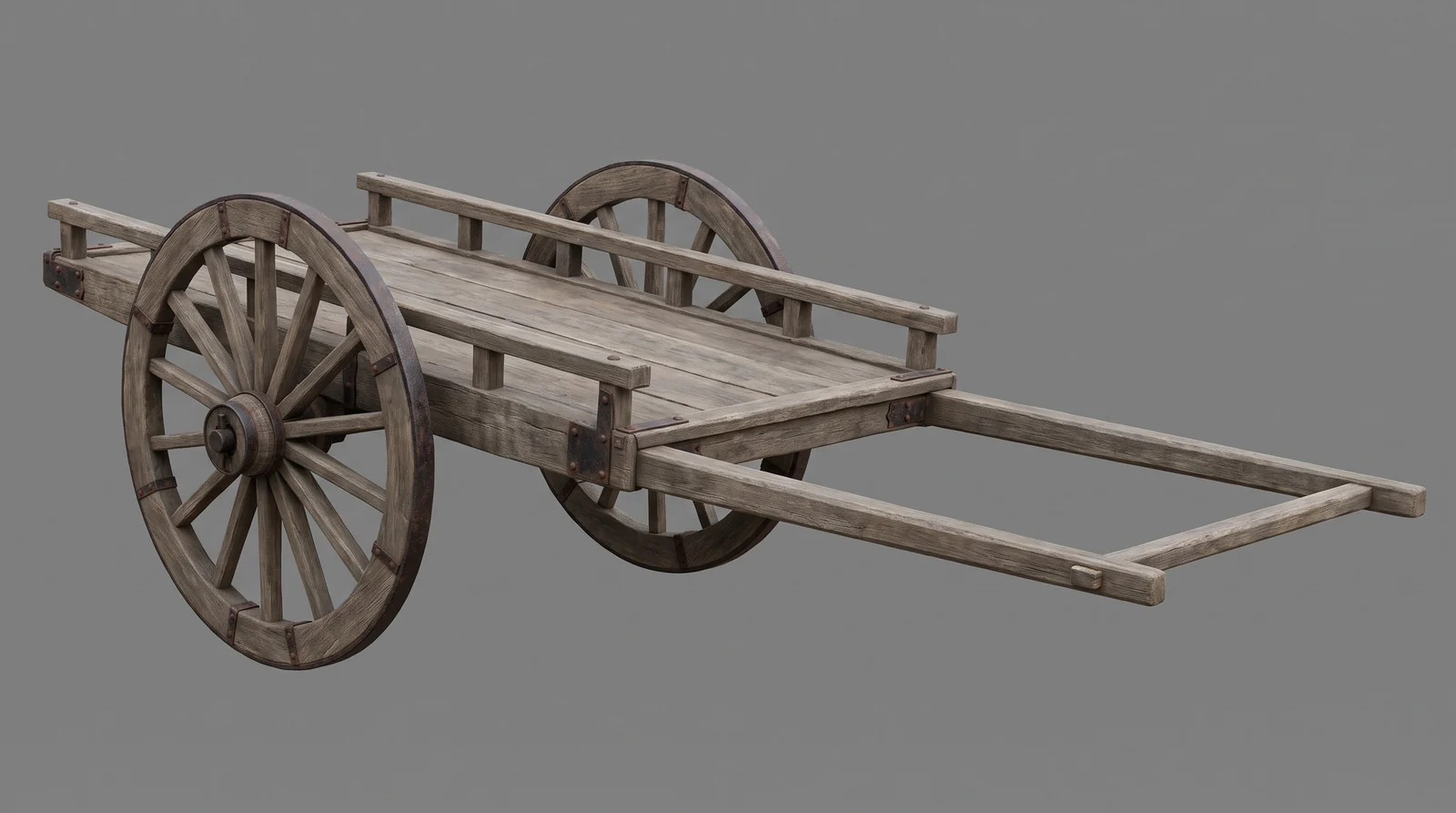
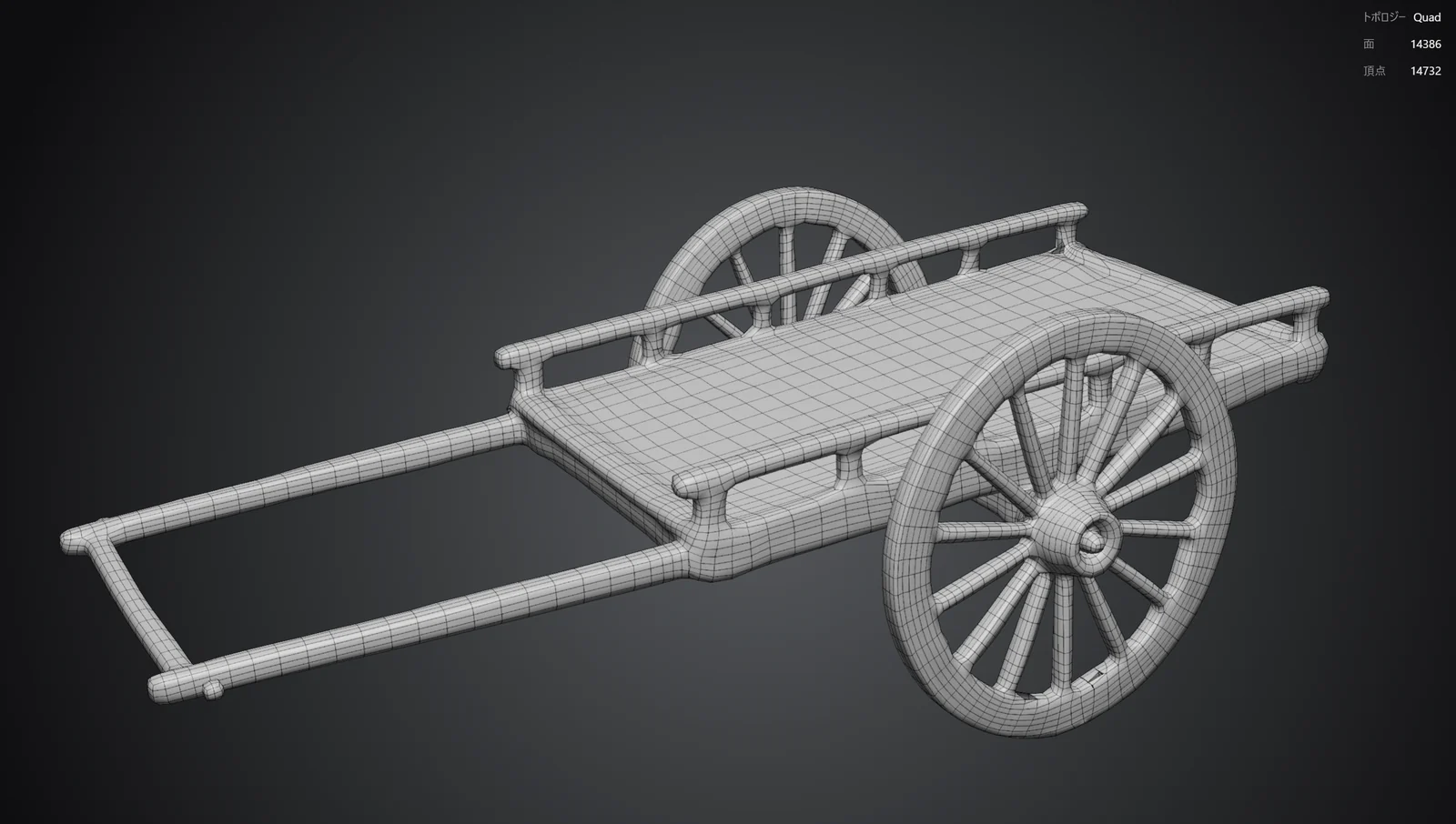
The basis for the decision was a round of testing on a daihachi cart and a chair.
Meshy's Game Ready output was not enough to use as a background asset.
The best at this point was Tripo P2.0's Game Ready, which stands at the entrance to practical use — though not at a level you can simply place, and it required a fair amount of manual correction.
I also tried routing a Hi3D-generated mesh through Tripo's quad remesh, but the rounding of edges and boundaries did not go away.
判断の材料は、大八車と椅子を題材にした一通りの検証です。
Meshy の Game Ready 出力は、背景アセットとして使うには足りませんでした。
現時点でいちばん良かったのは Tripo P2.0 の Game Ready で、これは実用の入口に立っています。
ただし、そのまま置ける水準ではなく、それなりの手作業の修正が要りました。
Hi3D で生成したメッシュに Tripo の quad remesh をかける経路も試しましたが、エッジと境界の丸まりは消えませんでした。
Some Problems Retopology Cannot Fix リトポロジーでは直らない問題がある
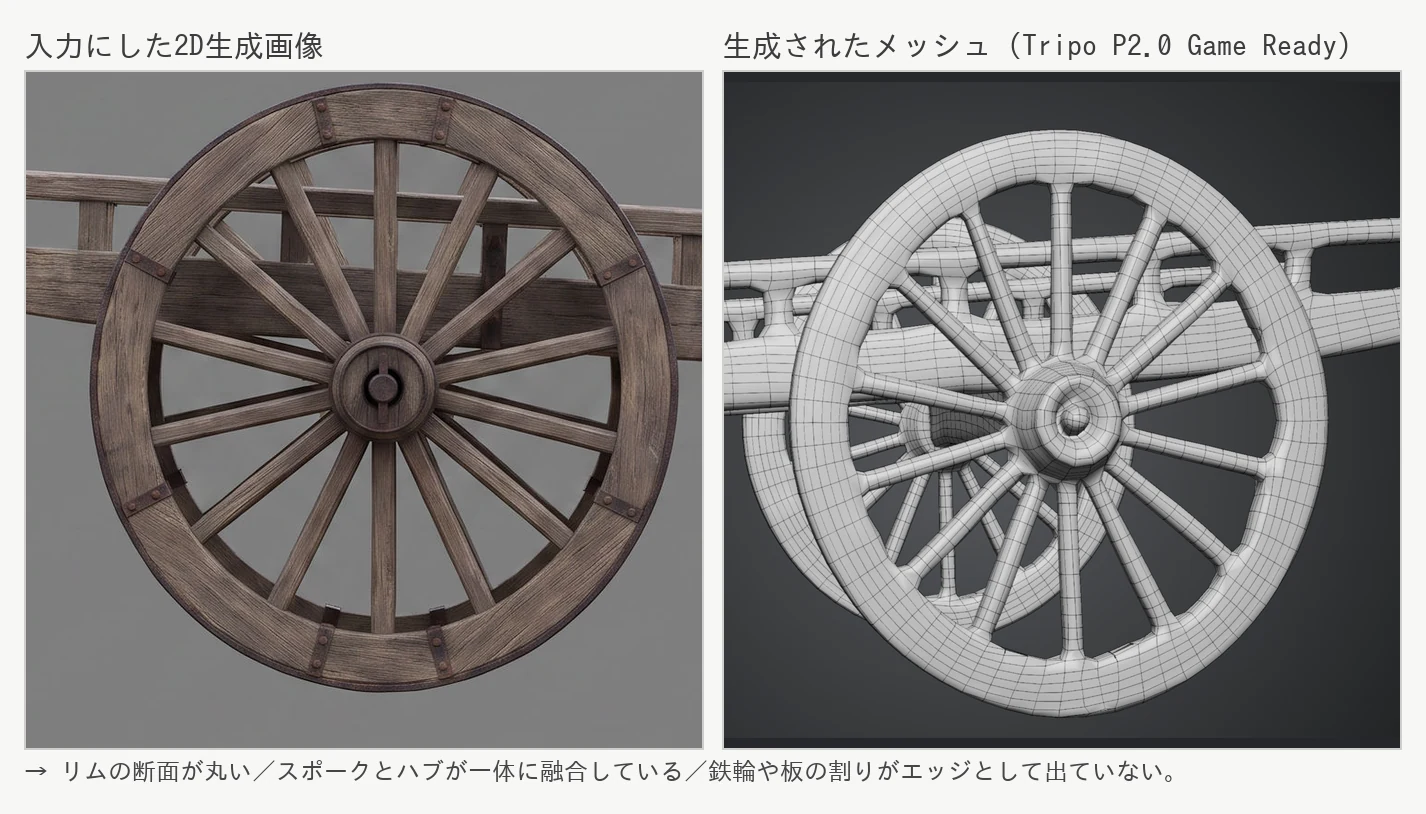
What mattered here was separating problems that can be fixed downstream from problems already decided upstream.
Rounded edges do not come back by changing the remeshing algorithm, because the information was lost at the moment of generation.
To be sure, I bought and ran Blender's Quadremesh Tools Pro; there was nothing wrong with the tool's functionality.
The bottleneck was not the tool but the generative model.
This was not the kind of problem you solve by switching tools.
ここで効いたのは、後段で直せる問題と上流で決まってしまう問題を分けて見ることでした。
丸まったエッジは、リメッシュのアルゴリズムを変えても戻りません。
生成の時点で情報が失われているからです。
念のため Blender の Quadremesh Tools Pro を購入して動かしましたが、ツールの機能に問題はありませんでした。
ボトルネックはツールではなく、生成モデルの側にありました。
道具を替えて解決する種類の問題ではなかった、ということです。
Shape Fidelity Is Already High Enough 形状の忠実度は、もう十分に高い
To avoid any misunderstanding: on the single point of dimensional reproduction, current services are already at a practical level.
I put a common-framed four-view set of an ambulance through each service and measured the ratio of the longest to the middle axis from the bounding box of the generated GLB.
The reference 2D material itself sat between 2.121 and 2.165; Hi3D v3.0 gave 2.120 in high-quality mode and 2.174 in master mode.
Since the input material differs by 2% between left and right, the error on the generation side is smaller than the variation within the material itself.
In other words, shape fidelity has reached the point of being capped by the quality of the source.
That I still don't use it as a deliverable has nothing to do with fidelity.
誤解のないように書いておくと、寸法の再現という一点では、現在のサービスはすでに実用水準です。
救急車の4視点素材を共通フレーム化したうえで各サービスに通し、生成された GLB のバウンディングボックスから長辺と中辺の比を測りました。
参照となる2D素材自身の値が 2.121 から 2.165 で、Hi3D v3.0 は高品質モードで 2.120、master モードで 2.174 でした。
入力素材は左右で 2% ずれているので、生成側の誤差は素材自身の揺れより小さいことになります。
つまり形状の忠実度は、素材の質で頭打ちになるところまで来ています。
それでも納品物に使わないのは、忠実度とは別の理由です。
So What Do I Use It For? では、何に使うのか
I narrowed what I hand to AI down to two areas: generation and assistance.
On the generation side, three things — concept art, seamless base textures, and base models intended to be baked down to low poly.
On the assistance side: help operating Blender, which I'm still getting used to; assembling complex node setups in Houdini; and support in turning finished assets into a game inside Unreal Engine.
In practice the procedure runs like this: produce a base with Tripo P2.0, then either retopologize and lay out UVs in a DCC, or bake textures from the raw high poly onto a hand-built low poly, adding segmentation where needed, and finish in Substance Painter.
At that split, AI accounts for 30 to 50 percent and hand work for 50 to 70 percent.
AIに任せる範囲を、生成とアシストの2つに絞りました。
生成側は、コンセプトアート、シームレスな下地テクスチャ、そしてローポリへのベイクを前提にした下地モデルの3つです。
アシスト側は、まだ不慣れな Blender の操作補助、Houdini の複雑なノードの組み立て、そして出来上がったアセットを Unreal Engine 上でゲームに仕立てる作業の補助です。
実際の手順は、Tripo P2.0 で下地を出し、DCCでリトポとUVを整えるか、あるいは素のハイポリから手作りのローポリへテクスチャをベイクし、必要ならセグメンテーションを入れて、最後に Substance Painter で仕上げる、という流れになります。
この配分だと、AIが3割から5割、手作業が5割から7割です。
Where the Line Sits for Publishing and Selling 掲載と販売の線引き
On my own asset site I publish only what has been finished by hand.
That said, I have no intention of slowing the publishing pace, so speeding up the loop from base generation through baking to Substance Painter is the main battleground for now.
As for the marketplaces: TurboSquid does not accept AI-generated work.
Unity Asset Store and Fab allow it provided you disclose that it was used.
ArtStation and Sketchfab were sold by Epic Games to KitBash in August 2026 and no new policy has been issued yet.
But the terms of service are not why I drew my line.
Even where the terms permit it, I don't ship something a viewer can tell.
自分のアセットサイトでは、手作業で仕上げたものだけを載せます。
ただし、掲載のペースを落とすつもりはありません。
そのために下地の生成からベイク、Substance Painter までのループを速くすることが、当面の主戦場になります。
販売先の規約も見ておくと、TurboSquid はAI生成物を受け付けません。
Unity Asset Store と Fab は、使ったことを開示すれば掲載できます。
ArtStation と Sketchfab は2026年8月に Epic Games から KitBash へ売却されたばかりで、新しい方針はまだ出ていません。
ただ、私が線を引いた理由は規約ではありません。
規約が許しても、見る人に分かってしまうものは出さない、というだけのことです。
It's interesting as technology, and dimensional reproduction is beyond complaint at this point.
Even so, I won't ship a generated mesh as it stands.
As a base, I could start using it tomorrow.
That is my judgment as of the end of August 2026.
I'll move this line as quality improves, but the criterion for moving it is not "when nobody can tell by looking" — it's "when I can explain the topology and UVs myself."
技術としては面白いですし、寸法の再現はもう文句のない水準です。
それでも私は、生成したメッシュをそのまま出すことはしません。
下地としてなら明日から使えます。
これが2026年8月末時点の私の判断です。
この線は品質が上がれば動かしますが、動かす基準は「見て分からなくなったとき」ではなく、「トポロジーとUVを自分で説明できるとき」に置いておきます。
Part of: このテーマの全体像: The Current State of AI-Generated 3D Creations AI 3D生成の現在地